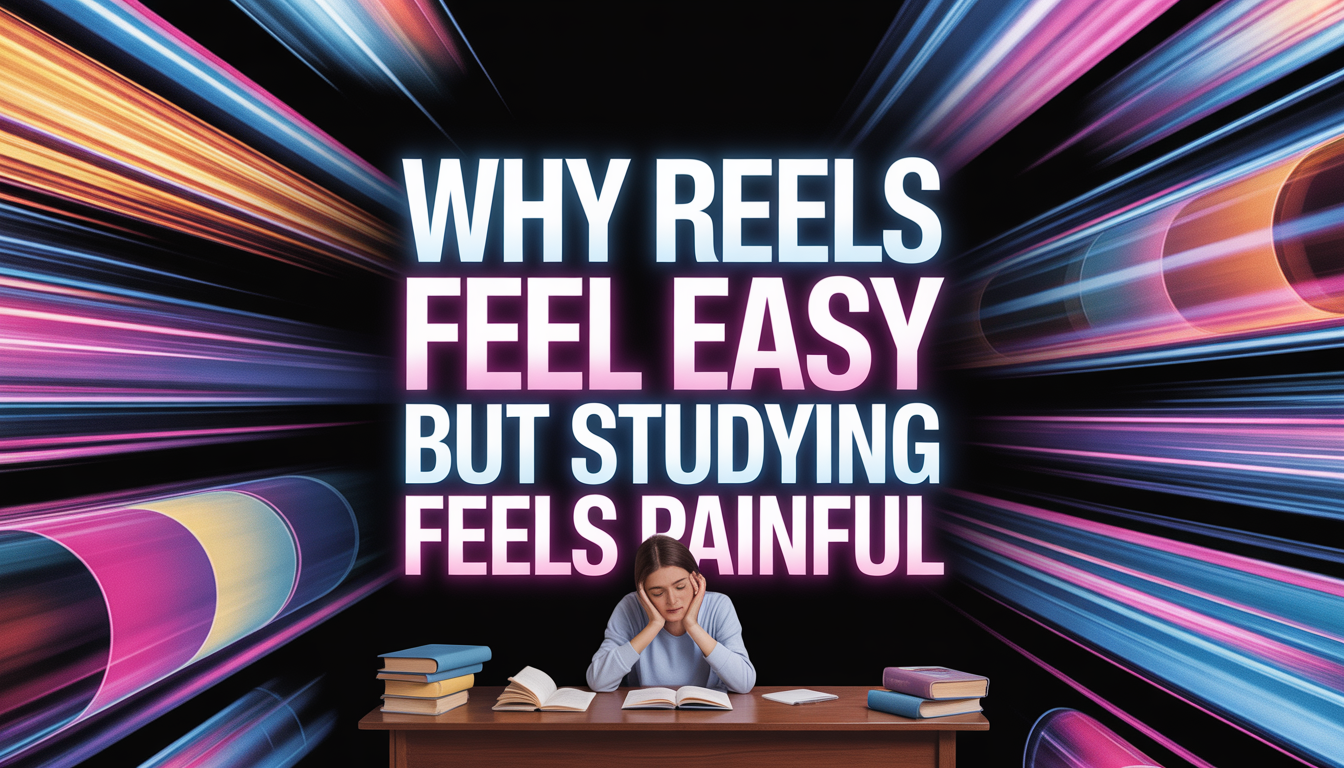
You already know this feeling.
You open Instagram or YouTube “just for five minutes.” Suddenly, three hours have gone by. You didn’t feel bored. You didn’t feel tired. You didn’t question your life choices. You kept scrolling. Every reel felt interesting. Time moved fast.
Now compare that to studying.
You sit down with your math book. Twenty-five minutes feels like two hours. You check the clock every few minutes. You feel restless. Your brain searches for escape. Even before starting, you feel mentally exhausted.
Why does this happen?
Most people answer with one simple word: interest. They say reels are interesting, and studying is boring. Reels give dopamine. Studying doesn’t.
That answer is partially correct. But it’s incomplete. There’s deeper psychology behind this difference. And once you understand it, you can rewire your brain to make studying feel rewarding too.
Let’s break it down properly.
Understanding the Dopamine and Novelty Trap:
When you scroll through reels, your brain experiences constant novelty. Novelty simply means something new. A new face. A new joke. A new sound. A new idea. Every few seconds, your brain receives fresh stimulation. Evolution designed your brain to pay attention to new stimuli because, historically, new things could signal opportunity or danger. Either way, they mattered.
Each new reel triggers a small dopamine spike. Dopamine is not just the pleasure chemical; it is the motivation chemical. It pushes you to continue seeking. That is why scrolling feels effortless. Your brain expects a reward every few seconds, and it keeps getting one.
Studying, however, works differently. When you open a math or chemistry book, there is no rapid novelty. There is no instant reward. The benefits are delayed, often by months or even years. Your brain compares both activities. One offers quick dopamine with minimal effort. The other demands effort with a delayed payoff. Naturally, your brain leans toward the easier reward system.
This isn’t about laziness. It’s about how your brain is wired. But wiring can be rewired.
The Real Issue Is Emotional Association, Not Boredom:
Most students believe they hate studying because it’s boring. But boredom is usually a surface-level explanation. The deeper issue is emotional association.
Your brain automatically connects activities with feelings. Over time, these connections become strong and unconscious. You have likely associated reels with relaxation, pleasure, escape, and entertainment. On the other hand, you may have associated studying with pressure, exams, fear of failure, parental expectations, and stress.
So when you sit down to study, your brain does not interpret it as “learning.” It interprets it as stress. And because your brain is designed to avoid discomfort, it nudges you toward something emotionally safer, like scrolling or gaming.
The problem is not discipline. The problem is emotional wiring. And emotional wiring can be redesigned.
How Dissociation and Association Can Rewire Your Mind:
The concept of dissociation and association is simple but powerful. Dissociation means mentally separating an activity from the negative emotions attached to it. Association means deliberately linking that activity to a meaningful and desirable future outcome.
Right now, when you think about studying math, you may associate it with difficulty and boredom. But what if you intentionally shift the association? Instead of focusing on “I have to solve equations for 25 minutes,” focus on what those 25 minutes represent.
Studying leads to better exam results. Better results increase the chances of admission into a stronger academic environment. A better environment increases the likelihood of being surrounded by ambitious and focused individuals. Your environment shapes your mindset, and your mindset shapes your opportunities.
Suddenly, those 25 minutes are no longer just math. They become a stepping stone toward a better version of your life. This shift transforms the task from meaningless effort into purposeful action.
How the Brain Responds to Future Rewards:
Psychological research shows that the brain can release dopamine not only from immediate rewards but also from vividly imagined future rewards. When you clearly visualize a future that excites you, your brain begins to anticipate it. That anticipation itself creates motivation.
This is why athletes visualize winning before competitions. This is why entrepreneurs imagine their success long before it happens. The brain does not completely differentiate between a vividly imagined future and a present experience. If you emotionally connect studying with a future identity you truly desire, your brain begins to treat the task differently.
Studying stops feeling random. It starts feeling strategic. Purpose reduces resistance.
Why This Technique Requires Practice:
You might try this approach once and still feel bored. That’s normal. Your brain has spent years associating studying with pressure and entertainment with pleasure. Changing those patterns takes repetition.
In the beginning, your mind will still crave fast dopamine. It will still resist effort. But each time you consciously connect your study session to your future identity and long-term rewards, you strengthen a new neural pathway.
Over time, the association becomes automatic. Instead of feeling stress when you open your book, you begin to feel progress. Instead of seeing effort as punishment, you see it as an investment. This shift doesn’t happen overnight. But gradual rewiring creates lasting change.
The Difference Between Scrolling and Succeeding:
Most successful individuals regularly perform tasks that are not exciting. They read when others scroll. They practice when others relax. They repeat fundamentals while others chase constant stimulation.
The difference is not that they naturally enjoy boring tasks. The difference is that they have trained their brain to associate effort with identity and long-term reward. They don’t see studying or practicing as isolated actions. They see them as steps toward becoming someone.
When you move from “I have to study” to “I am becoming disciplined,” your motivation shifts from mood-based to identity-based. Mood fluctuates. Identity is stable. Identity-driven action is powerful.
Turning Study Sessions Into Meaningful Steps:
The next time you sit down to study, don’t obsess over the clock. Instead, zoom out mentally. See your life as a long timeline. Imagine this study session as a small but significant point on that line.
You are not just solving equations. You are training your brain to think logically. You are not memorizing facts. You are strengthening focus. You are not just preparing for an exam. You are preparing for future environments, opportunities, and relationships.
When your brain understands that this effort contributes to a meaningful narrative, resistance decreases. Not instantly, but gradually. And gradual change is sustainable change.
Final Reflection:
Reels feel easy because they offer constant novelty and immediate dopamine. Studying feels hard because its rewards are delayed and emotionally disconnected from the present moment.
The solution is not to force yourself through sheer willpower. The solution is to redesign your emotional associations. Dissociate the boredom from the task. Associate the task with a powerful and desirable future identity.
Repeat this process consistently. At first, it may feel artificial. Over time, it becomes natural.
And once your brain links effort with growth and identity, you will not depend on temporary motivation. You will act because it aligns with who you are becoming.
That is the real shift from scrolling aimlessly to moving intentionally toward your future.
FAQs:
1. Why does scrolling reels feel easier than studying?
Scrolling reels feels easy because each new video provides constant novelty, triggering small dopamine spikes. Your brain receives instant rewards every few seconds, whereas studying offers delayed benefits and requires sustained effort, making it feel harder.
2. Is studying boring, or is there a deeper reason?
The deeper reason is emotional association, not boredom. Many students associate studying with stress, exams, and pressure, while scrolling is linked to pleasure and relaxation. Your brain avoids activities tied to negative emotions and seeks those linked to immediate reward.
3. What are dissociation and association in learning?
Dissociation means separating a task from negative emotions, while association means connecting it to meaningful and desirable outcomes. For studying, this could mean linking a math session to long-term success, better opportunities, or a future identity you want to achieve.
4. How can I train my brain to enjoy studying?
Visualize a desirable future outcome connected to your study session. Imagine the benefits, like better exams, improved skills, and opportunities. Repeating this consistently rewires your brain, making effort feel purposeful rather than tedious.
5. How long does it take to rewire my brain for studying?
It requires consistent practice. At first, your mind may still crave instant dopamine from reels, but each time you associate studying with future rewards, neural pathways strengthen. Gradually, studying becomes natural, effortful tasks feel meaningful, and motivation shifts from mood-based to identity-based.